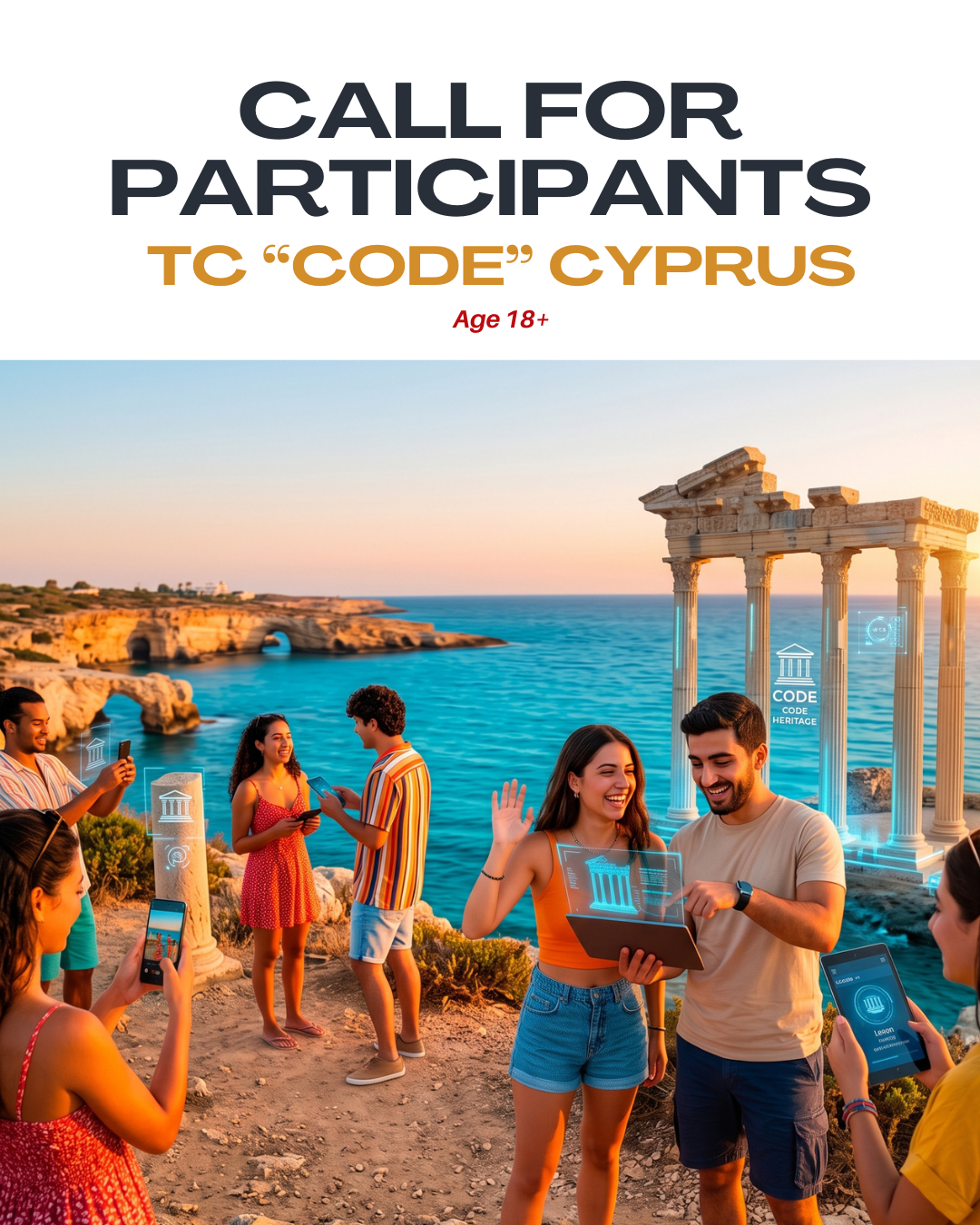
The project CODE is designed to enhance young people’s engagement with European cultural and democratic heritage by making cultural participation more accessible, meaningful, and closely connected to their everyday experiences. From a youth work
perspective, the project prioritizes the empowerment of youth workers as key intermediaries capable of motivating and guiding young people toward active cultural participation.
A central objective of the project is to strengthen youth workers’ professional competences through the provision of innovative methodologies, combining digital and analog tools to address diverse learning styles and participation needs. By adopting participatory
approaches, such as storytelling, creative workshops, and multimedia practices, the project aims to shift young people’s role from passive consumers of cultural content to active contributors and interpreters of heritage. In doing so, the initiative supports intercultural dialogue, social cohesion, and the development of a shared European sense of belonging, while explicitly addressing economic, geographic, and social barriers that often restrict young people’s access to cultural life
Activities
The project will be implemented through a seven-day international training programme involving 30 youth workers from partner organisations. Participants were actively engaged during the preparatory phase through needs analysis and represented experienced and motivated professionals committed to strengthening youth engagement with cultural heritage within their local contexts.
The training programme is structured around four interrelated phases. The initial phase focuses on group building and intercultural exchange through interactive methods such as ice-breakers, energisers, and narrative-based activities. This is followed by a theoretical and analytical phase, which provides participants with a shared knowledge base on European cultural heritage, youth engagement strategies, and the Erasmus+ framework through facilitated discussions, visual tools, and data-informed reflection.
The third phase emphasizes experiential learning, enabling participants to apply newly acquired knowledge through practical activities, including storytelling laboratories, role-playing exercises, digital content creation, and visits to cultural sites. The programme concludes with a production-oriented phase, during which participants collaboratively develop concrete outputs such as virtual exhibitions, youth-oriented manuals, short audiovisual materials, and draft proposals for future cultural projects.
DEADLINE 18.09.26
Application Form: https://visa-form.bitrix24site.ru/crm_form_34k5t/