
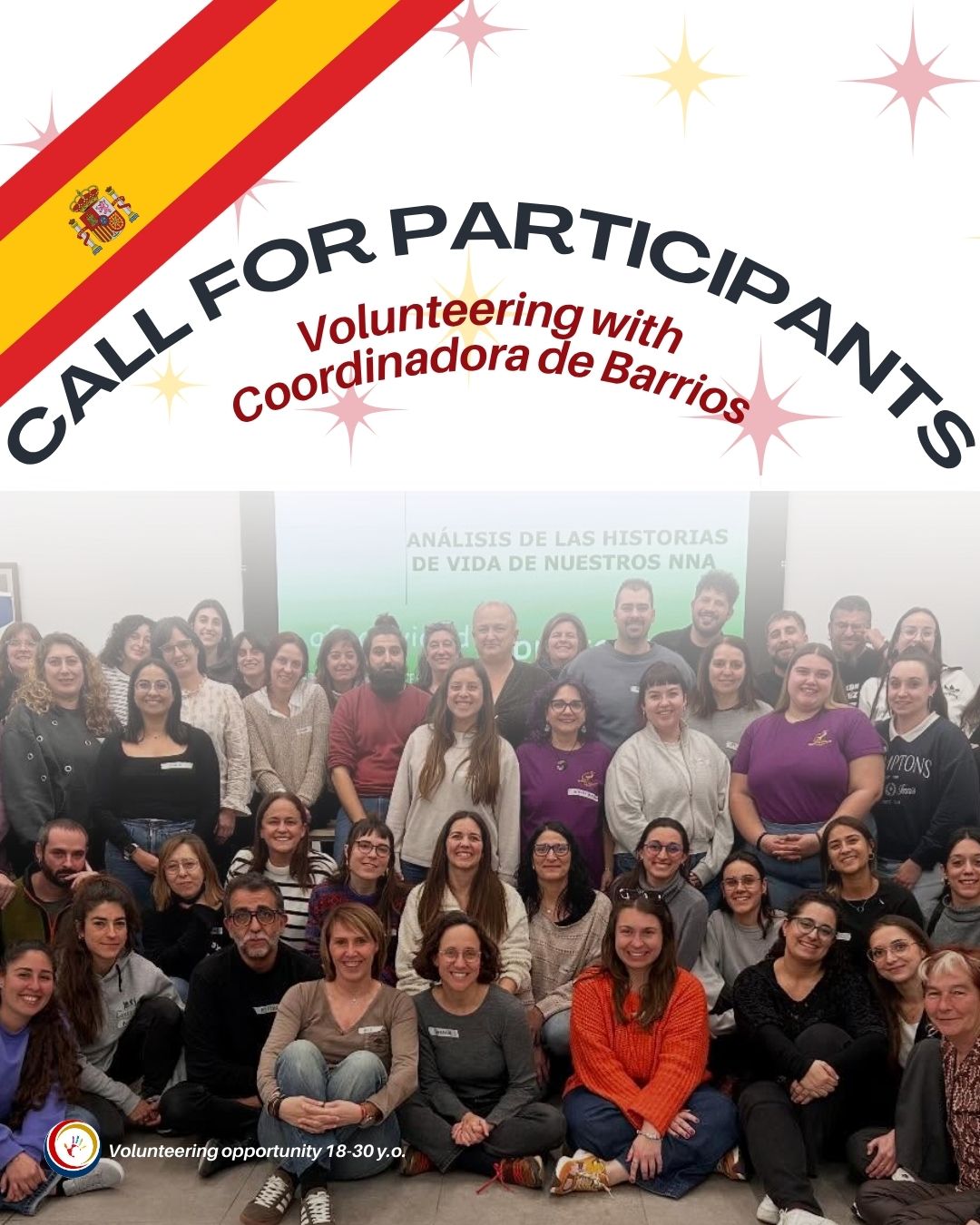
General Information
Start: Sep. 2026
End: Jul. 2027
The volunteer will be involved in various tasks throughout the project, with a weekly schedule ranging between 30 and 38 hours.
This project takes place mainly in Los Rosales, a neighborhood in the El Palmar district of Murcia. For decades, this area has experienced significant socioeconomic decline, facing serious issues related to housing, social exclusion, and overall deterioration—urban, physical, and social. The community also faces major challenges in the social and labor integration of its residents.
The volunteer’s main areas of involvement will include:
1. Educational Support for Primary and Secondary School Students (Afternoons). From Monday to Friday, volunteers will support the educational reinforcement sessions and related activities:
- 15:30–17:00 – Academic support for primary school children.
- 17:00–17:30 – Leisure activities with an educational focus (e.g. games, crafts).
- 17:30–19:00 – Academic support for secondary school students.
- 19:00–20:00 – Leisure activities for the secondary group, co-designed and agreed upon with the students (e.g. games, creative workshops).
2. Family Support Activities (Mornings). During the mornings, volunteers may take part in:
- Providing support and supervision for families.
- Participating in workshops with women and child protection initiatives.
- Supporting workshops on gender equality and intercultural learning.
- Spanish classes: Twice a week, from 9:00 to 13:00 (depending on the volunteer’s language level).
3. Promotion of European Programs. Occasionally, volunteers will help organize and take part in workshops and presentations about the European Solidarity Corps (ESC) in:
- Youth organizations
- High schools
- The University of Murcia
4. Summer School (June–July). The summer school runs for four weeks, from Monday to Thursday, 9:00–13:00, and focuses on a central theme (e.g. travel, art, cooking). Activities are designed for primary school children (up to 40 participants) and include:
- Creative workshops using recycled materials
- Games and group dynamics
- Local excursions and outdoor activities
5. Community-Based Activities in Los Rosales: Volunteers will also participate in community intervention initiatives, working alongside social organizations, schools, and the local city council. These quarterly activities are designed to involve both children and their families in the life of the neighborhood. The highlight is “La Fuente de las Culturas,” a major community event held one Saturday in May, featuring a morning of multicultural games, workshops, and festivities.
6. Possible New Community Projects (Subject to Approval and Development): In addition, the organization is currently exploring the development of new community-based initiatives focused on the prevention of gender-based violence and the empowerment of women, both in El Palmar and in the neighborhood of La Paz (Murcia).
Depending on the needs identified within the community and the approval of these projects, volunteers may have the opportunity to participate in activities aimed at women, such as digital literacy workshops, sports and wellbeing activities, educational sessions, and other social participation initiatives adapted to the context and needs of the neighborhood.
As these initiatives are still in the planning and development phase, the volunteer’s participation in these activities cannot be guaranteed, although it may be possible if the projects are implemented during the volunteering period.
Our volunteering project seeks to promote the values promoted by the EU and the ESC Programme, such as solidarity, equality, justice, respect, the fight against exclusion and xenophobia, etc.
More Information About the Volunteer’s Life
Practical arrangements: The schedule of the volunteer activities will be between 30 and 38 hours per week. The volunteer will work max. 38 hours on 5 days per week.
Holidays: According to the rules of ESC, volunteers must have 2 working days off per month.
Accommodation: The volunteers will live in a room in a shared flat located in the city of Murcia together with other volunteers. The room and the flat will be fully equipped, and electricity, water, gas and internet will be covered by the lead organization (till the amount of 30€ per volunteer).
Pocket money: The volunteer will receive the monthly rate foreseen by the Spanish NA, 186€ per month.
Food: The volunteer will receive 184€ for food every month.
Local transport: Every volunteer will have a chance to choose a bike or bus card provided by the hosting organization if it is needed.
Language support: The volunteer is entitled to receive language support with an online platform, as stated on the ESC programme guide.
Medical insurance: The volunteer will be covered by a private insurance that will cover all the expenses not covered by the public health system (health, accident and civil liability insurance).
Travel costs: The volunteer will receive financial support for travel from his/her country to Spain and from Spain to his/her country once the project is completed, up to a maximum amount established by the European Commission according to the distance band.
Visa and residence permit fees: The volunteer will receive financial support for visa arrangements (if required).
Deposit: The volunteer will have to make a 370€ deposit that will be reimbursed once the project is ended and the volunteer leaves tidy, clean, and with no damage in the private room and common areas, and if the volunteer doesn’t leave the project without a justified reason before it ends.
How to Apply
Anyone interested after reading the info above, fill in this form : https://b24-hiozxe.bitrix24site.ru/crm_form_rrp7v/
Volunteer Profile
This project is aimed at young people between 18 and 30 years old who have not participated in any European volunteering project (EVS or ESC) before. We will give priority to the selection of young people with fewer opportunities.
The selection will be made based on the attitude, the willingness to participate, the motivation and the commitment to the values of the project rather than knowledge and skills of the candidates .
We value the responsibility, the spirit of initiative, the patience and the ability to step back from interpersonal conflicts in order to deal with them more effectively, and the enthusiasm and willingness to participate in the different activities offered.
No young person willing to participate in our project will be excluded for any reason (economic difficulties; social or geographical obstacles; cultural or ideological differences; sexual orientation, age, ethnicity, gender and gender identity, etc.).
About Coordinadora de Barrios
Coordinadora de Barrios is a non-profit organization with more than 30 years of experience working with people at risk of marginalization and social exclusion. We have a long history of working with young people and their families in the framework of the prevention of social exclusion in some of the most marginalized areas of the city of Murcia.
The work is mainly focused on the quality of life and integration of children at risk of social exclusion in our area through different projects and activities, and supporting their families.
We have been working in different areas and municipalities of the Region of Murcia since 1986. The organization is made up of four groups (neighborhood collectives) that develop and implement different projects that work in specific areas, sadly famous for the high risk of social exclusion of their inhabitants: Barrio de Los Rosales in El Palmar, Barrio de Santa Rosa de Lima / San Pedro in Alcantarilla, Barrio Espíritu Santo in Espinardo and Barrio del Polígono de la Paz in Murcia.
Our work began in the 90s as a response to the needs of the boys and girls living in Los Rosales: family problems, poverty and economic struggle, lack of trust in the educational system, early school-leaving, lack of space for activities of leisure where to have fun and live together.
The objectives of the Coordinadora de Barrios are:
– Addressing the problems of dysfunctional children, young people and adults, in order to respond to these situations through direct interventions and support.
– Provide support and supervision where needed (urban areas, police stations, prisons, centers for drug addicts, etc.).
– To get close to the concerns and anxieties of families and individuals in general, and to get involved and help them look for possible solutions.
– Promote education and raise public awareness on these issues, developing critical analysis of situations that become an obstacle to the integration process.
– Coordinate the work in the different areas and cooperate with the many organizations or institutions that share the same objectives.