
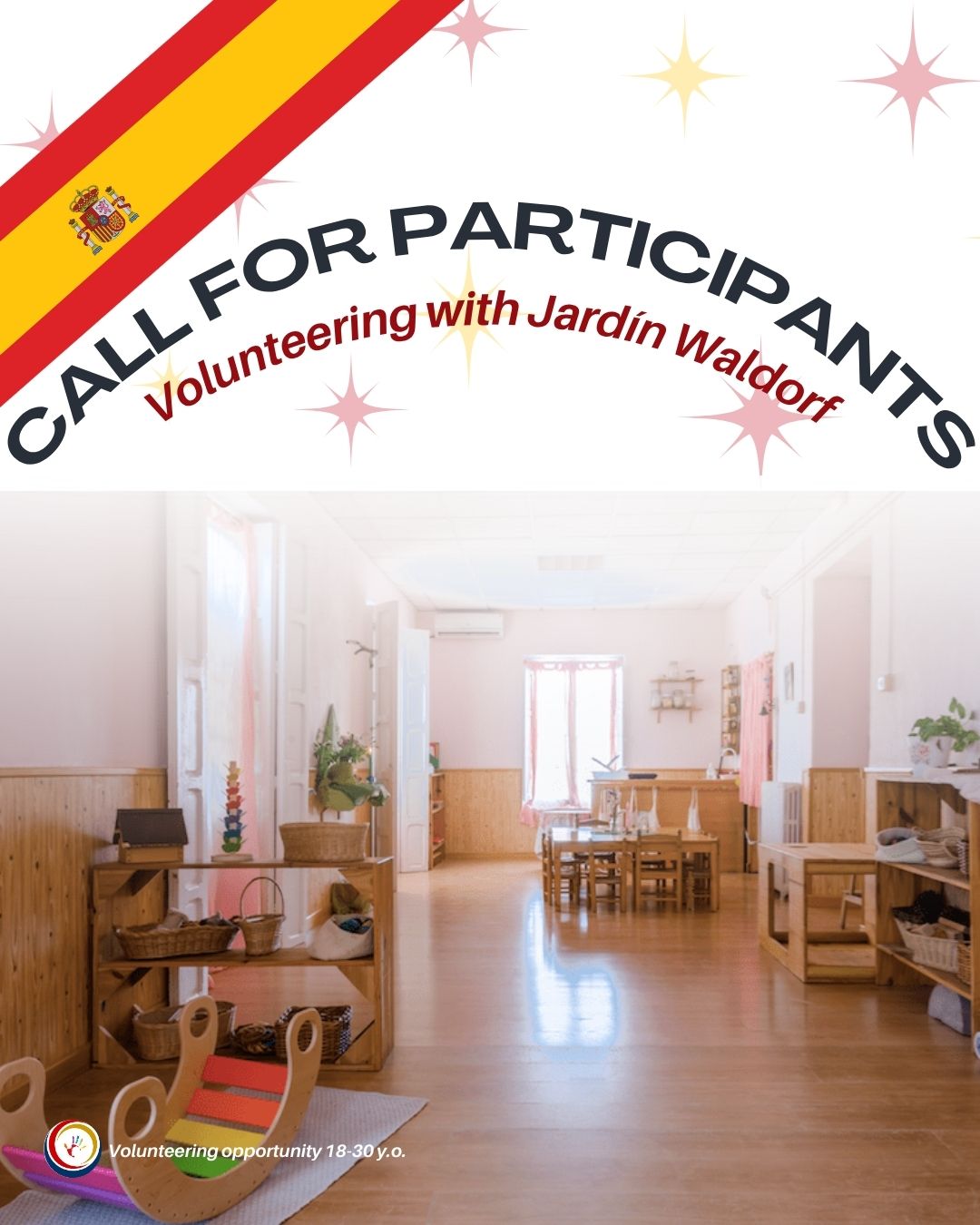
General Information
Start: Sep. 2026
End: Jul. 2027
Several tasks will be assigned to the participant. The main role of the volunteer is to accompany and support the teacher in daily activities. This includes:
· Greeting children upon arrival and assisting with shoes or personal belongings if necessary.
· Supervising and participating in free play, as well as preparing breakfast together with the children and the teacher.
· Assisting children with handwashing, organizing materials, and maintaining the classroom space.
· Supporting children during outdoor activities in the garden, attending to their needs, and preparing the classroom for the next activity.
· Assisting the teacher and children during bathroom routines and lunchtime.
· Participating in storytime sessions and helping with dismissal.
· Supporting classroom transitions, helping children in the dining area, maintaining a calm environment, and preparing the classroom for upcoming activities.
· Taking part in quarterly school celebrations.
· Supporting maintenance of activity spaces, including tidying, cleaning, decorating, and gardening.
· Assisting in workshops for children and parents.
· Participating in staff meetings to learn educational resources such as songs, fingerplays, and stories used daily in the classrooms, as well as contributing to the organization of annual Waldorf school festivities.
In addition, the volunteer will also participate in the following activities:
· Promoting European projects, programs, and mobility opportunities among young people in the Region of Murcia, as well as among the users of the organization.
· Participating in workshops and presentations about the European Solidarity Corps (ESC) program in youth organizations, secondary schools in the city of Murcia, and the University of Murcia.
· Creating monthly content to share updates about the organization’s activities, helping to disseminate and increase the visibility of project results.
Working hours: The volunteer’s schedule will generally be from 9:00 a.m. to 3:00 p.m. or 9:00 a.m. to 4:00 p.m., depending on the needs of the school. Occasionally, volunteers may be asked to work some afternoons or a Saturday morning.
Through the project activities, the volunteer will have the opportunity to learn:
· Basic knowledge of Waldorf education through daily activities with children, on the one hand and, on the other hand, by participating in the study workshops, conferences and trainings organized by our association on topics related to this pedagogy;
· Management of skills such as: willingness, patience, respect, etc.
· Teamwork and participation in meetings with our collaborators and members, decision making, etc.
· How to interact with children and understand their needs and support them throughout the day.
· How to use imagination in play, as the Waldorf ideology is to use nature during play, such as wood, stones and materials, instead of common plastic toys.
Waldorf pedagogy offers a very broad vision of the human being that points towards self- education, and finding it can be a source of growth for our volunteer.
In addition, the volunteer will learn to work in groups with teachers, parents, and mothers in a dynamic and responsible way. For handicraft lovers it is without doubt a source of creativity and a good opportunity to learn to work with noble materials.
Our volunteering project seeks to promote the values promoted by the EU and the ESC Programme, such as solidarity, equality, justice, respect, the fight against exclusion and xenophobia, etc.
How to Apply
Anyone interested after reading the info above, fill in this form: https://b24-hiozxe.bitrix24site.ru/crm_form_bx9zr/
More Information About the Volunteer’s Life
Practical arrangements: The schedule of the volunteer activities will be between 30 and 38 hours per week. The volunteer will work max. 38 hours on 5 days per week.
Holidays: According to the rules of ESC, volunteers must have 2 working days off per month.
Accommodation: The volunteers will live in a room in a shared flat located in the city of Murcia together with other volunteers. The room and the flat will be fully equipped, and electricity, water, gas and internet will be covered by the lead organization (till the amount of 30€ per volunteer).
Pocket money: The volunteer will receive the monthly rate foreseen by the Spanish NA, 186€ per month.
Food: The volunteer will receive 184€ for food every month.
Local transport: Every volunteer will have a chance to choose a bike or bus card provided by the hosting organization if it is needed.
Language support: The volunteer is entitled to receive language support with an online platform, as stated on the ESC programme guide.
Medical insurance: The volunteer will be covered by a private insurance that will cover all the expenses not covered by the public health system (health, accident and civil liability insurance).
Travel costs: The volunteer will receive financial support for travel from his/her country to Spain and from Spain to his/her country once the project is completed, up to a maximum amount established by the European Commission according to the distance band.
Visa and residence permit fees: The volunteer will receive financial support for visa arrangements (if required).
Deposit: The volunteer will have to make a 370€ deposit that will be reimbursed once the project is ended and the volunteer leaves tidy, clean, and with no damage in the private room and common areas, and if the volunteer doesn’t leave the project without a justified reason before it ends.
Volunteer Profile
This project is aimed at young people between 18 and 30 years old who have not participated in any European volunteering project (EVS or ESC) before. We will give priority to the selection of young people with fewer opportunities.
The selection will be made based on the attitude, the willingness to participate, the motivation and the commitment to the values of the project rather than knowledge and skills of the candidates .
We value the responsibility, the spirit of initiative, the patience and the ability to step back from interpersonal conflicts in order to deal with them more effectively, and the enthusiasm and willingness to participate in the different activities offered.
No young person willing to participate in our project will be excluded for any reason (economic difficulties; social or geographical obstacles; cultural or ideological differences; sexual orientation, age, ethnicity, gender and gender identity, etc.).
About Jardín Waldorf Murcia
The aim of Asociación Jardín Waldorf de Murcia is to develop and promote the education of the human being using Waldorf pedagogy through formal education within the Spanish educational system.
In order to fulfill the purposes listed in the previous article we carried out the following activities:
· Educational and recreational initiatives that promote the encounter between families of our collaborators.
· Organization of conferences, courses, exhibitions, workshops and other educational activities for children, young people, parents and teachers for the theoretical and practical development of the founding principles of the Association.
· Organisation of markets, open days and informative talks.
· Publication and distribution of brochures, newsletters, magazines and all kinds of publications.
· And all those events and activities that contribute to the understanding and development of Waldorf education.
Our association consists of employees and teachers trained in Waldorf education.
The Asociación Jardín Waldorf de Murcia is made up of parents, currently members, who have the same intention: to educate their children through Waldorf pedagogy.
Our association welcomes children between 18 months and 6 years old. What differentiates our educational approach from others is the importance given to movement, the use of art, imitation through observation, rather than intellectual activities. The teachers observe the children and take care of them in a personalized way, according to the internal evolution of each child, respecting the evolutionary process of each one of them.
Music, art and free play are basic elements in our teaching methods. Songs are integrated into everyday activities, while the children draw, paint, play, mould beeswax, make bread, etc. The materials used in our activities are noble and natural materials such as wax for drawing, wood, beeswax for moulding, wool, organic fabrics, etc. The children spend half of their time in the garden, being in contact with nature, movement is essential at this early stage of life. Children climb trees, jump, run, play with the ground, jump in puddles, etc., because for them everything is discovery and movement. Through play they learn to relate and interact with each other. If there are conflicts between them, the teachers support them in handling them in a very respectful way. The children participate in all the activities, such as: picking up and cleaning the classroom, setting the table for lunch, making bread, cutting vegetables, etc.
The association has three classrooms that are distributed according to the number of children and their ages in each school year.
Our association is currently located in La Alberca, a district of Murcia, about 15 minutes drive from the centre of Murcia, in a natural environment.